Van Gogh Museum

Why visit

Who will love it

{ "attraction": "Van Gogh Museum", "summary": "The world's largest collection of works by Vincent van Gogh, featuring iconic masterpieces like Sunflowers, The Potato Eaters, and Almond Blossom alongside his personal letters.", "price_from": "€22", "duration": "2 hours", "best_time": "9:00 AM or after 4:00 PM", "booking_required": "Yes", "district": "Museumkwartier", "verdict": "Art enthusiasts and those interested in the psychological journey of a creator should make this a top priority.

The museum expertly traces Van Gogh's evolution from his somber early Dutch period to the vibrant, frantic energy of his final years in France, providing a narrative depth that few single-artist museums can match.\n\nIf you are a spontaneous traveler, you will likely have to skip this, as tickets frequently sell out several weeks in advance.

Those who prefer a broad overview of art history rather than a deep dive into one individual may find the neighboring Rijksmuseum a more efficient use of their time.\n\nEssential: Tickets are only available online for specific time slots; there is no physical box office for walk-in purchases." }

Who should skip it

Not specified yet

What to know beforehand

{ "summary": "A profound, narrative-driven journey through Van Gogh’s evolution that requires a high tolerance for dense crowds.", "body": "The museum is masterfully organized to trace Vincent’s psychological and artistic transition from the somber tones of his Dutch period to the explosive colors of Arles.

However, the experience is often defined by the sheer volume of visitors; expect to view iconic works like Sunflowers and The Bedroom over several rows of shoulders.

It is a must-visit for those who value the story behind the art, but the rigid one-way flow and constant movement can feel more like a logistical exercise than a tranquil gallery visit.\n\nPractical Note: The museum is entirely cashless, so ensure you have a card or mobile payment ready for the cloakroom and the museum cafe.", "best_time": "The 9:00 AM entry slot or Friday evenings after 6:00 PM.", "ticket_block": "Adult tickets are 22 EUR.

Admission is free for those under 18 and Museumkaart holders, though everyone must reserve a specific time slot in advance.", "prime_timing_block": "Early morning slots are the only way to see the main masterpieces with any degree of space.

Friday nights offer a more contemporary atmosphere and are generally avoided by large tour groups." }

🎫 Tickets, tours & discounts

[ { "attraction": "Van Gogh Museum", "city": "Amsterdam", "price_from": "22", "currency": "EUR", "booking_required": true, "best_time": "9:00 AM or after 4:00 PM", "opening_hours": "9:00 AM - 6:00 PM", "nearest_metro": "Tram 2, 5, 12 (Museumplein stop)", "duration": "2 - 2.5 hours", "editorial": "### Which ticket to choose\n\nThe standard entrance ticket is the primary option and provides access to all permanent collections and temporary exhibitions.

For most visitors, the basic ticket is sufficient, but adding the multimedia guide is highly recommended.

It provides a deep narrative layer that explains the evolution of Vincent’s techniques and his mental health struggles, which are not always obvious from the wall text alone.\n\n- Standard Entry: Best for those who prefer to explore at their own pace or are using a city pass.\n- Entry + Multimedia Guide: The best value for first-time visitors wanting a structured narrative.\n\nThe most frequent mistake travelers make is assuming they can buy tickets at the door.

The museum operates on a strict pre-booked time slot system; there is no physical ticket desk for same-day sales, and slots often sell out two weeks in advance.\n\n### Best time to visit\n\nThe museum is most congested between 11:00 AM and 3:00 PM when tour groups and school trips are at their peak.

To see iconic works like \"Sunflowers\" or \"Almond Blossom\" without standing three rows deep, book the first slot at 9:00 AM or a late afternoon slot after 4:00 PM. \n\nFor photographers and those seeking a quiet atmosphere, the final two hours of operation are the calmest.

The museum is well-lit with artificial light designed to protect the paintings, so the experience remains consistent regardless of the weather outside.\n\n### Combos and discounts\n\nThe I amsterdam City Card includes entry to the Van Gogh Museum, but it is critical to remember that having the card does not guarantee entry; you must still book a specific time slot online in advance.

The Museumkaart (Netherlands Museum Pass) also grants free entry with a pre-booked slot.\n\nChildren and teenagers under the age of 18 enter for free, though they still require a reserved time-slot ticket.

There are no specific discounts for seniors, but students can often access reduced rates on weekdays by presenting a valid International Student Identity Card (ISIC).\n\n### When a guided tour makes sense\n\nA professional guided tour is worth the cost if you are an art enthusiast who wants to dive into the technical details of Post-Impressionism or the specific provenance of the works.

Guides often share stories from Vincent’s letters to his brother Theo that provide a much more intimate perspective than the standard displays.\n\nIf you are a casual visitor or traveling with young children who might lose focus during a 90-minute lecture, the multimedia guide is a better choice.

It allows you to skip sections or spend more time on specific masterpieces without being tied to a group's pace.\n\nImportant: If you miss your designated 30-minute entry window, the museum may deny access without a refund, as capacity is strictly regulated for the safety of the artworks." } ]

Weather nowLight haze
Amsterdam, The Netherlands
NowClear night 🌙
Temperature18°C
VisibilityGood
AerosolsLight haze · AOD 0.29

Conditions are mixed — plan accordingly and check for covered areas.

AOD — how much dust and haze in the air dim the distant view. 0 clean, >0.4 noticeable, >0.7 heavy.

Crowd indicator

The museum operates near full capacity year-round due to strict time-slot ticketing, with peak congestion occurring midday.

When to go?

Mini-calculator based on crowd levels by day and time.

Best time at Mon — 18:00

This day is usually noticeably busy. This slot has a higher chance of a comfortable visit: Museum closing. Weather is currently not ideal: clear night 🌙.

30–50% · Quiet60–80% · Moderate90–100% · Crowded

Nearest days

TodayExpect maximum capacity today; time slots are strictly enforced.
10:0075%
12:00100%
14:0095%
16:0070%
17:0050%
18:0010%
TomorrowAnother heavily booked weekend day; midday galleries will be dense.
10:0070%
12:0095%
14:0095%
16:0065%
17:0045%
18:0010%
Day after tomorrowWeekday traffic is slightly lower, though early afternoon remains congested.
10:0060%
12:0085%
14:0085%
16:0055%
17:0035%
18:0010%

How to find the entrance

1
"Entrance instructions": "Museumplein ArrivalLocate the modern glass pavilion situated in the open square between the major museums\nTime Slot Check | Join the queue outside the glass entrance matching the specific time on your digital ticket\nSecurity and Scanning | Pass through the mandatory bag inspection and scan your ticket at the automated entry gates\nLower Level Entry | Descend via the stairs or lift to the basement floor to find the cloakroom and galleries",

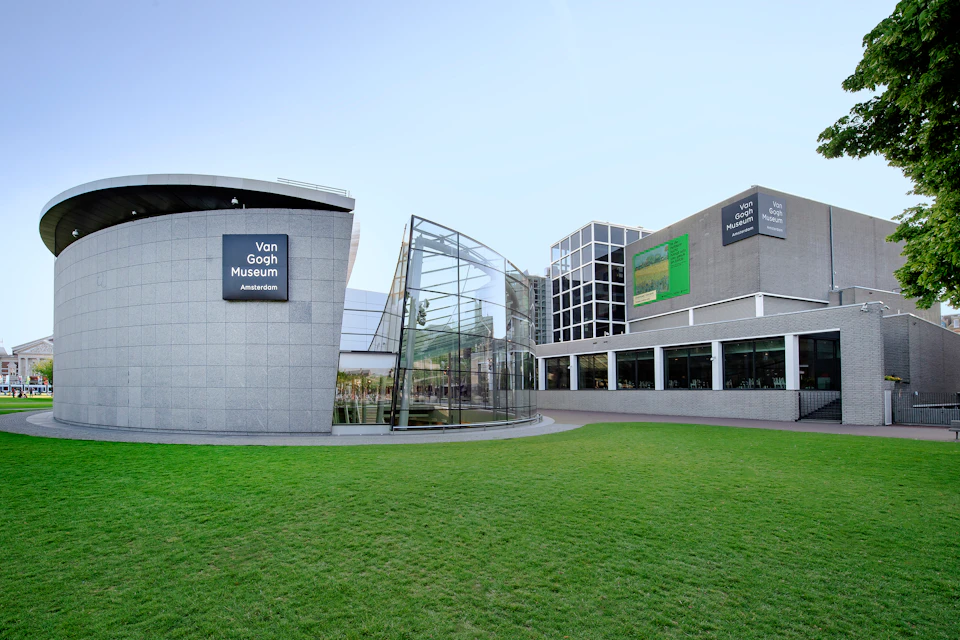
[ { "Attraction": "Van Gogh Museum", "Address": "Museumplein 6, 1071 DJ Amsterdam", "Nearest transit": "Tram lines 2, 5, or 12 to Van Baerlestraat; Tram lines 3, 5, or 12 to Museumplein", "District": "Museumkwartier", "Summary": "The world's largest collection of works by Vincent van Gogh, located in a dedicated complex on the Museum Square.", "Entrance Instructions": "The museum is located on the Museumplein, and the entrance is found within the modern glass wing rather than the original brick building.

When you arrive at the square, look for the large, transparent oval structure; this is the primary entry point for all visitors. \n\nEntry is strictly organized by pre-booked time slots. You should aim to arrive exactly at the time indicated on your ticket, as staff manage the queue based on these windows.

Even with a confirmed booking, expect a short wait in the outdoor line before being ushered into the glass pavilion.\n\nOnce inside, you will descend to the lower level for a security screening. This process is mandatory and includes a bag check.

If you are carrying a backpack or a large bag, you must leave it at the cloakroom, which is free of charge, as only small purses are allowed in the exhibition spaces.\n\n- Arriving more than 30 minutes past your scheduled time can lead to your ticket being invalidated.\n- Security checks typically add 10 to 15 minutes to the entry process during busy periods.\n- Large umbrellas and bulky items must be stored in the cloakroom before you can proceed to the galleries.\n\nImportant: Tickets are not available for purchase at the museum entrance.

You must have a digital or printed ticket with a specific time slot already secured before you join the queue." } ]

Practical limits & what to bring

{ "practical_notes": "### What to consider before your visit\n\nEntry is strictly managed through pre-booked time slots, and you must purchase your ticket online in advance. There are no ticket sales at the museum entrance, and popular dates often sell out weeks ahead.

Expect a high density of visitors in the galleries, especially around iconic works like Sunflowers. To experience a quieter atmosphere, book the earliest morning slot at 9:00 or visit during the final ninety minutes before closing.\n\nSecurity screening is mandatory for all guests.

While there is no formal dress code, the museum is climate-controlled to protect the art, which can feel warm when the galleries are crowded.

Photography and filming of the artworks are strictly prohibited to preserve the viewing experience and protect the collection; however, designated photo walls are available in the atrium.\n\n### What is allowed and what is forbidden\n\n- No photography or video recording of the original artworks.\n- No professional cameras, tripods, or selfie sticks.\n- No food or drinks are permitted inside the exhibition rooms.\n- No umbrellas, large backpacks, or bulky items.\n- Small bags and backpacks (maximum size of an A4 sheet of paper) are allowed inside.\n- Sealed water bottles may be carried but must remain inside your bag while in the galleries.\n\n### Storage and belongings\n\nThe museum provides a free cloakroom on the ground floor where you can leave coats, small bags, and umbrellas.

Storage space is limited and cannot accommodate suitcases, large travel backpacks, or sports equipment. Any item larger than a small daypack will be denied entry, and there are no oversized lockers on-site.

Strollers and wheelchairs are permitted in the galleries, and the building is fully equipped with elevators for easy access between floors.\n\nTip: If you are traveling with luggage, use the automated lockers at Amsterdam Centraal Station or a private luggage storage service in the Museumplein area before your visit." }

Location and what's nearby

{ "location_context": "### About the district\n- The Museumkwartier is Amsterdam's premier cultural hub, defined by the vast Museumplein lawn and grand 19th-century architecture.\n- It is a sophisticated, high-density area where world-class art institutions sit alongside high-end residential streets and luxury boutiques.\n- The district is perfect for a full day of cultural exploration followed by a refined evening in the park or upscale dining.\n\n### Nearby on foot (up to 15 minutes)\n- Rijksmuseum — The national museum of the Netherlands housing masterpieces by Rembrandt and Vermeer · 3 min walk\n- Stedelijk Museum — A major hub for modern and contemporary art and design · 2 min walk\n- Vondelpark — Amsterdam's largest city park perfect for a stroll or people-watching · 6 min walk\n- Concertgebouw — One of the world's most famous concert halls with exceptional acoustics · 5 min walk\n- P.C.

Hooftstraat — The city's most exclusive street for luxury fashion and designer boutiques · 4 min walk\n- Moco Museum — Boutique museum showcasing iconic works by Banksy and modern masters · 2 min walk\n- Albert Cuyp Market — The largest outdoor market in Europe located in the vibrant Pijp · 14 min walk\n\n### 15–30 minutes by transport\n- Anne Frank House — The historic canal house where Anne Frank lived in hiding · 18 min by tram\n- Dam Square — The historical heart of the city featuring the Royal Palace and New Church · 18 min by tram\n- Rembrandt House Museum — The former home and studio where the famous artist lived and worked · 22 min by tram\n\n### Where to eat nearby\n- Rijks — Michelin-starred Dutch cuisine using locally sourced seasonal ingredients · expensive · booking essential · 5 min walk\n- The Seafood Bar — Fresh sustainable seafood in a bright and modern setting · mid-range · booking recommended · 4 min walk\n- Small Talk — Cozy neighborhood cafe serving traditional Dutch pancakes and sandwiches · mid-range · no booking needed · 3 min walk\n- Brasserie Keyzer — Historic landmark restaurant known for classic service and seafood · expensive · booking recommended · 5 min walk\n\n### Daily itinerary\nBegin your morning at the Rijksmuseum to see the Old Masters before heading to the Van Gogh Museum for its vibrant collection.

Enjoy a fresh lunch at The Seafood Bar on Van Baerlestraat, then spend your afternoon wandering through the green paths of Vondelpark. End the day with luxury window-shopping on P.C.

Hooftstraat or a world-class performance at the Concertgebouw.\n\nNote: Start at the Rijksmuseum early to avoid the largest crowds before moving to the Van Gogh Museum, as the two share the same plaza." }

Reference

Facts

Read more

[ { "### Numbers and Scale": [ "- Collection Size: 200 paintings, 400 drawings, and over 700 personal letters, making it the largest concentrated assembly of the artist's work globally.", "- Annual Capacity: 2.1 million visitors pass through the galleries in a typical year, ranking it as one of the most-frequented art institutions in Europe.", "- Glass Entrance: 600 square meters of structural glass were used for the foyer, featuring 12-meter-long glass fins that support the entire roof without steel pillars.", "- Exhibition Space: 4 floors of gallery area in the main Rietveld building provide a chronological journey through the artist's mental and creative evolution.", "- Construction Timeline: The original building took 10 years to complete from the initial design phase to the public opening." ], "### Myths and Misconceptions": [ "- Myth: Vincent van Gogh only sold a single painting, The Red Vineyard, during his entire career.

In reality: He sold at least several other works, including a self-portrait to an art dealer and multiple commissioned drawings.", "- Myth: The artist cut off his entire ear during a famous mental health crisis.

In reality: Historical evidence and medical diagrams from the era indicate he severed only a significant portion of his left ear lobe.", "- Myth: The museum is located in a historical residence where the Van Gogh family once lived.

In reality: The museum is a purpose-built modern complex on Museum Square, as Vincent never lived in Amsterdam during his years as an artist." ], "### Rare and Unusual": [ "- Secret Sketches: Infrared reflectography has revealed entirely different compositions and preparatory drawings hidden beneath the surface of famous works like The Potato Eaters.", "- The Theo Connection: The collection exists because Vincent's sister-in-law, Jo van Gogh-Bonger, spent decades promoting the work after both Vincent and his brother Theo had passed away.", "- Architectural Contrast: The Kurokawa Wing is shaped like an ellipse and finished in titanium and grey granite to represent a sunken stone, contrasting the functionalist lines of the main building.", "- Letter Archives: The museum houses the original correspondence between the brothers, which serves as a near-daily diary of the artist's technical struggles and philosophical thoughts.", "- The Yellow House: While the museum displays the famous painting of the Yellow House in Arles, the actual building was destroyed by an aerial bomb during World War II." ] } ]

Background

History

Read more

[ { "summary": "The Van Gogh Museum houses the world's largest collection of works by Vincent van Gogh, preserved through the dedication of his family to ensure his creative legacy remained in Amsterdam.", "body": "The museum exists because of the persistence of the Van Gogh family.

After Vincent’s death, his brother Theo and later Theo’s widow, Jo van Gogh-Bonger, meticulously preserved the vast collection of paintings and letters that had remained unsold during the artist's life.

In 1962, the artist's nephew established the Vincent van Gogh Foundation to keep the collection together, leading to the opening of this dedicated space.\n\n### Modernist Design and Expansion\nThe main building is a landmark of Dutch modernism, designed by architect Gerrit Rietveld to prioritize natural light and open spaces.

This minimalist environment ensures that the intense colors of the canvases remain the focal point.

A striking glass entrance hall and an elliptical exhibition wing were added later to accommodate the millions of visitors who come to trace the artist's evolution.\n\nFor today's visitor, the museum is more than a gallery; it is a chronological narrative of a self-taught artist who redefined modern art in just one decade.

With over 200 paintings and 500 drawings, the collection provides an unparalleled look at the technical shifts and personal struggles behind world-famous masterpieces like Sunflowers and The Potato Eaters." } ]

♿ Accessibility & families

{ "accessibility_and_family_policy": { "short_accessibility_flag": "Fully accessible with elevators to all floors and free wheelchair loans.", "child_friendly": "Yes, with free entry for minors and interactive activity trails.", "mobility_access": "The museum is fully optimized for wheelchair users and visitors with reduced mobility.

All floors are serviced by spacious elevators, and the building features level thresholds throughout the galleries. Manual wheelchairs are available for loan at the information desk on a first-come, first-served basis.

Accessible restrooms are located on the ground floor and in the exhibition wing.", "family_and_stroller_policy": "Admission is free for all visitors under the age of 18.

Strollers and buggies are permitted in all gallery spaces, though the museum recommends using compact models due to high visitor density near famous works like Sunflowers.

Children under the age of 12 must be accompanied by an adult at all times.", "amenities_and_constraints": "A free cloakroom is available for coats and small bags, but large backpacks and suitcases are not permitted and cannot be stored on-site.

To keep children engaged, the museum offers a free scavenger hunt available at the information desk. Multimedia guides specifically designed for children can be rented for 3 EUR." } }

🏢 On-site amenities

[ { "amenities": "## On-Site Facilities\n\nRestrooms are available on every floor of the museum, from the basement to the third floor. These facilities are free for ticket holders and include dedicated accessible toilets and baby-changing stations.

Free high-speed Wi-Fi is accessible throughout the building by connecting to the museum's guest network.\n\n## Dining and Shopping\n\nMuseumcafé Le Tambourin, located on the ground floor, serves a variety of sandwiches, salads, and pastries in a bright, casual setting overlooking Museumplein.

For shopping, the main Museum Shop on the ground floor offers an extensive collection of art books, high-quality prints, and Van Gogh-themed stationery.

A smaller satellite shop is located on the third floor for quick souvenir purchases.\n\n## Practical Essentials\n\nDrinking fountains are located near the restroom areas. While you may carry a small water bottle in your bag, drinking is strictly prohibited in the gallery spaces and is only permitted within the cafe.

A free cloakroom is available for coats, umbrellas, and small bags (maximum size A4).

Please note that large backpacks, suitcases, and strollers must be checked, though the museum cannot accommodate oversized luggage exceeding 55 x 35 x 25 cm.\n\n## Family Services\n\nIn addition to baby-changing tables in the restrooms, a private nursing room is available for parents.

You can request access to this room at the information desk in the entrance hall." } ]

Reliability & freshness

UpdatedMay 26, 2026

I’ve lived in Amsterdam for seven years and write clear, practical guides to getting around the Netherlands without guesswork.